
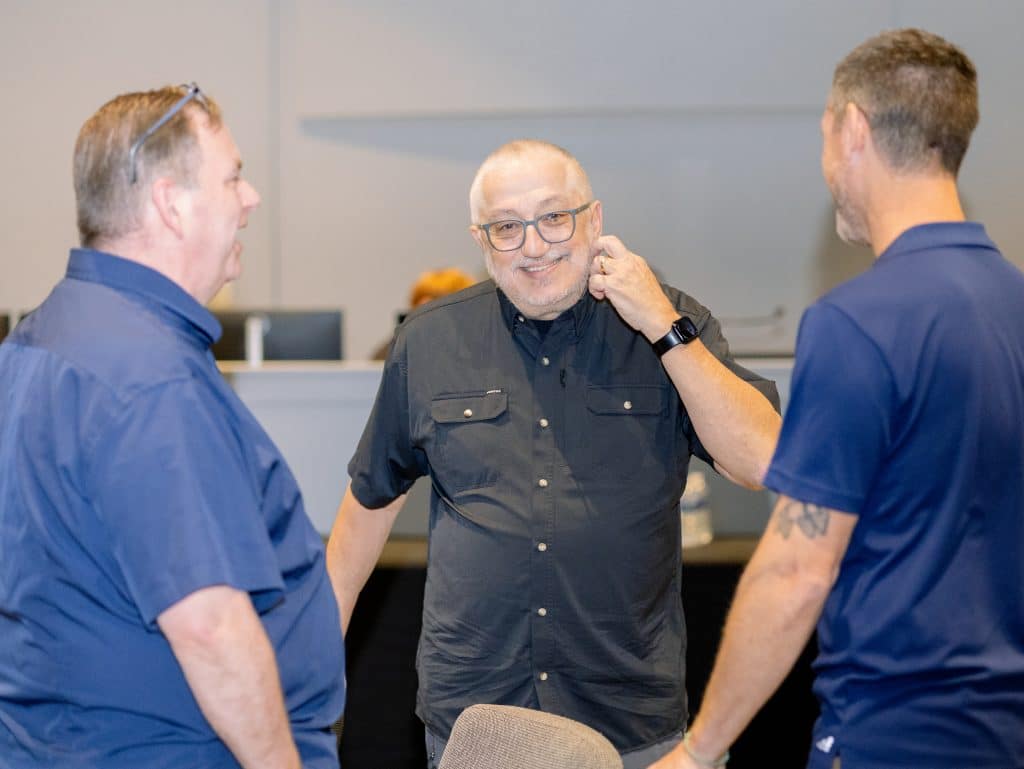
One of the few undergraduate courses that I still get to teach at Manna University is Mentoring and Coaching. Almost every undergraduate student takes the course, which means I get the opportunity to connect with nearly every student who journeys through our university.
One of the things I tell students early in the course is that formation rarely happens in isolation. Information can be consumed alone. Formation usually cannot.
That lesson has been reinforced every time I step onto the mats for Brazilian Jiu-Jitsu.
I love BJJ, and after years of training, a little competing (it’s been a decade), teaching, and getting humbled regularly, I’ve realized the sport teaches the same lessons over and over again.
I am stronger than I think I am. I am weaker than I think I am. What I fuel my body and mind with matters. Rest matters. Repetition matters. Good things often come through suffering.
However, one lesson rises above the rest: Community matters.
Jiu-Jitsu may look like an individual sport during competition, but nobody learns it alone. It is impossible to train without partners (shout out to the Manna U BJJ crew!). Impossible to improve without teammates (much love Team Renzo Gracie Clarksville!). Impossible to grow without coaches correcting blind spots and sharpening weaknesses.
Theological education works the same way.
One of the strangest assumptions in modern education is the idea that information alone can form a person. It can inform someone, certainly. It can expose people to ideas, frameworks, and opportunities. But formation has always required more than access to information. It requires people.
Some of the most important moments in my own development did not happen in formal lectures. They happened in conversations after church services, on road trips with leaders, in offices with pastors and professors, or over meals where mentors spoke honestly about leadership, theology, failure, family, conflict, and faithfulness.
Much of what shaped me was caught, not merely taught.
That reality feels increasingly important in a moment where education is becoming more scalable, efficient, and digitally accessible than ever before. As I’ve said, I believe many of those innovations are genuinely helpful. Some of our students are balancing military assignments, parenting, full-time jobs, ministry responsibilities, and deployments while pursuing theological education.
The more scalable education becomes, the easier it is to unintentionally separate learning from relationships. Historically, theological education was deeply relational. Long before modern lecture halls and online learning platforms existed, formation happened through proximity, apprenticeship, correction, accountability, and shared rhythms of life.
This is one reason the Oxford tutorial model continues to fascinate me and why I’ve loved getting to present research and study there over the last two summers. In the original tutorial setting, students were not simply downloading information from experts. They were learning through close intellectual engagement, discussion, critique, and mentorship. The goal was not merely mastering content. The goal was formation.
There is something deeply human about that kind of learning.
It slows you down, exposes weak thinking, and teaches humility because your ideas no longer remain safely hidden inside your own head.
I often tell students that mentoring and coaching are costly because people are costly. Real mentorship requires time, attention, patience, correction, encouragement, and presence. Coaching is not merely telling someone what to do. Consulting is not merely offering solutions. The best mentors and coaches come alongside people and help them navigate obstacles while developing the wisdom to lead faithfully themselves.
Several years ago, I had the opportunity to meet Admiral Vern Clark, the former Chief of Naval Operations. During our conversation, he asked me about my doctoral program and how the non-traditional format was working for me. I gave him my standard answer at the time: “Sir, it is the hardest thing I have ever done in my life.”
He smiled, looked me directly in the eyes, and said, “GOOD! It’s supposed to be hard because life and leadership are hard.”
I’ve never forgotten that moment.
Formation is difficult because leadership is difficult. Anything worth having costs something. That is why mentorship still matters in theological education. The Church does not simply need leaders with information. It needs leaders who have been challenged, corrected, sharpened, encouraged, and formed in community over time.
Information may fill the mind, but mentorship helps shape the person.
Dr. Carlo A. Serrano, President