
Leadership looks different depending on where you stand.
That may sound obvious, but it is a lesson I keep relearning every time I travel to Rwanda. Not because leadership principles change across borders, but because context exposes assumptions we do not realize we are carrying. The longer I lead, the more convinced I am that leadership formation is not only shaped by what we believe, but by what our environment quietly allows us to avoid.
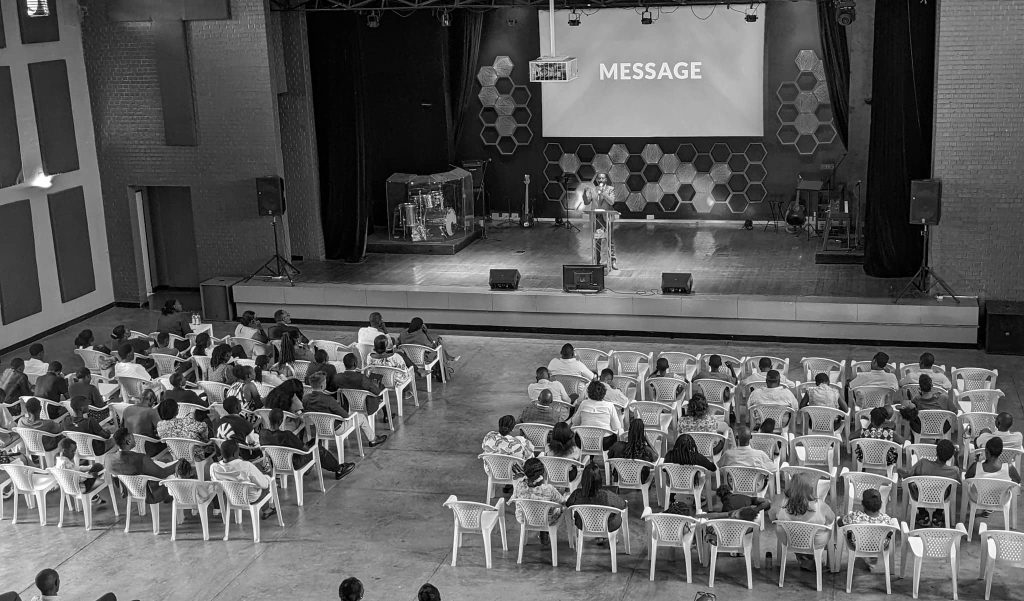
In 2022, Manna University partnered with Christ Hope Community Chapel in Kigali to provide accredited biblical higher education training to current and emerging leaders. Through our mentoring center and thanks to our flexible online programs, we’ve served over 50 students in programs ranging from a Certificate in Worship Ministry to a Master of Arts in Pastoral Counseling.
Whenever I discuss Rwanda with North Americans they either stare back in silence (because they have no idea where Rwanda is) or they ask about Rwanda’s darkest hours. In the early 1930s, Belgian colonists created a permanent division system by grouping the Rwandan people into 3 ethnic groups: Hutu, Tutsi, and Twa. Within 20 years, ethnic identity cards were used to control movement, commerce, and freedoms. In 1994 decades of division and hate erupted into 100 days of terror and one of the greatest acts of evil in history: a genocide where more than 800,000 people died.
I’ve spent a lot of time in Rwanda and although the country is almost 32 years removed from the genocide, the mistrust, pain, and scars of that time are still evident in the lives of everyday people. Status, ethnicity, and class may no longer be defined by ID cards, but the desire to be “better than the other” seems to permeate everything from shopping, to policing, to how people drive!
Just like the United States.
In many Western leadership settings, options are plentiful. When things get hard, leaders can pivot, rebrand, relocate, or step away. There is often another position, another platform, another opportunity just around the corner. That reality does not make leaders unfaithful. But it does shape how faithfulness is understood.
In Rwanda, leadership operates within a different set of constraints.
Many of the leaders I encounter there do not lead with the assumption that leaving is an option. Ministry, education, and community leadership are not treated as provisional assignments. They are long-term commitments embedded in place, people, and history. When challenges arise, the question is rarely, “Should I stay?” The question is, “How do we remain faithful here?”
That distinction matters.
What I have observed over years of returning to Rwanda is not heroic leadership or romanticized perseverance, although I’ve met legitimate heroes for sure. What I see instead is a steady presence. Church leaders who remain engaged through ambiguity. Educators like my friends at the University of Tourism, Technology, and Business Studies, who continue forming students without guarantees. I think of pastorslike Manna U alum Charles Mapendo, who shepherd communities shaped by collective memory and real loss. Faithfulness there is not framed as endurance for its own sake.
Rwanda has helped me see that leadership clarity often emerges where leaders cannot outsource responsibility or escape consequence. When leaders are rooted in place, leadership becomes less about momentum and more about trust. Less about speed and more about presence. Less about visibility and more about credibility earned over time.
This has also shaped how I think about resurrection hope.
In many Western Christian contexts, resurrection is celebrated as victory over suffering. I’ve had the joy of preaching in Kigali during Holy Week and in Rwanda, resurrection is often understood as God’s faithfulness within suffering. Hope there does not deny pain or rush past it. It walks toward it. Resurrection is not an escape plan. It is a promise that God is present even when resolution is delayed.
That theological posture has leadership implications.
If leadership formation happens only in environments where leaders can leave when things get uncomfortable, that formation will struggle to translate globally. Leaders may be gifted, articulate, and well-trained, but unprepared for contexts that require endurance rather than innovation. Global proximity exposes that gap, not to shame leaders, but to refine how they are formed.
This is one of the reasons Manna University’s global partnerships matter so deeply to me. They are not about exporting models or replicating systems. They are about allowing proximity to reshape formation. When students and leaders are formed alongside the global church, they begin to see leadership through a wider lens. They learn that faithfulness does not always look efficient. That obedience is not always rewarded quickly. That hope is often sustained quietly long before it is celebrated publicly.
Rwanda has taught me that leadership formation cannot be rushed without cost. It also cannot be abstracted from place without distortion. Leaders who are formed only in choice-rich environments may struggle when those choices narrow. Leaders formed with global awareness are better equipped to remain faithful regardless of context.
I am still learning this. Each visit deepens the lesson rather than resolving it.
Dr. Carlo A. Serrano, President