
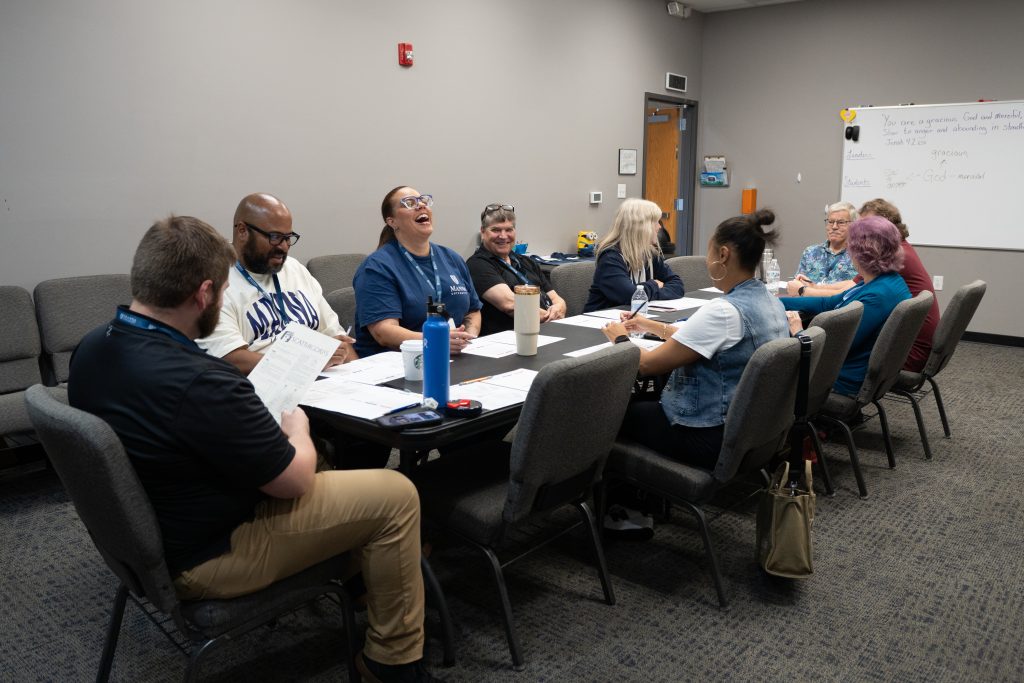
I have spent a surprising amount of my life on both sides of the table.
I’ve been a young soldier receiving an order and a C-suite leader giving one.
I’ve been a student wondering why a professor designed an assignment that way, and a professor explaining why I absolutely designed it that way.
I’ve sat in meetings wondering, “Why don’t they just fix this?”
Now I’m usually the “they.”
From one side of the table, a situation can look painfully obvious. Then you change seats.
Suddenly, you have information you didn’t have before. You understand constraints you never considered. You realize the person making the decision was balancing factors you couldn’t see. You feel weight you’ve never felt before.
Sometimes you discover that the decision you once criticized actually made sense.
Other times? You discover it was every bit as dumb as you thought it was.
Changing seats doesn’t automatically make the other side right. It does, however, give you perspective.
I remember my first week sitting at the desk as President of Manna U. I actually called a pastor friend and repented for all the years I spent criticizing and analyzing other leaders without understanding the weight of leadership.
As a student and faculty member, I experienced higher education primarily through my classes, assignments, tuition, and whatever administrative process I happened to be navigating at the time, which makes perfect sense. Students should not have to think about accreditation requirements while completing an assignment. They shouldn’t need to understand an institution’s financial model to register for classes. They experience the university through the portion directly in front of them.
Leading a university changes the view.
Now a seemingly simple decision might involve academic policy, compliance requirements, finances, technology, staffing capacity, and implications that won’t become visible for another year. As I type this, I’m 24 hours removed from a four-week international trip. I’ve had a Zoom meeting about a new initiative we’re working on in Colombia, counseled a student on a career change, and strategized about new faculty with our Executive Director of Academics.
There are moments when I think, “I had no idea how complicated this was.”
But there is a danger that comes with sitting on this side of the table.
You can forget what the other side felt like.
You can become so familiar with institutional complexity that you dismiss legitimate frustration.
“Well, they just don’t understand.”
Maybe they don’t, but understanding why something is complicated doesn’t make their experience of it any less frustrating.
That’s not reserved just for higher education. The same holds true for church ministry.
Pastors can forget what Sunday morning feels like for the person who isn’t on staff. Just like professors can forget what it feels like to take five classes while working a full-time job.
Executives can forget what a new policy looks like to the person who has to implement it. Supervisors can forget how intimidating it can be to disagree with the person who evaluates your performance.
Authority changes the room.
I don’t mean that negatively. Organizations need authority. Someone eventually has to make the call.
What I’m saying is that leaders should understand how their seat affects conversations.
People may choose their words more carefully around you. A casual comment may be interpreted as a directive. An idea you toss into a conversation may become someone’s project before you realize what happened. A criticism that feels minor coming out of your mouth may carry considerably more weight when it lands.
You cannot pretend positional authority doesn’t exist simply because you consider yourself approachable.
Your chair has weight.
In Mark 10, James and John approach Jesus about positions of authority in His Kingdom. The other disciples become angry, and Jesus uses the moment to address how authority works among His followers.
The rulers of the Gentiles, He says, “lord it over them.”
“But it shall not be so among you.”
Jesus does not pretend leadership doesn’t exist. Instead, He changes the leader’s relationship to power.
Authority becomes a responsibility to serve.
I don’t know about you, but I want to remember what it felt like to be the student, the soldier, the staff pastor, or the retail associate.
Those experiences can keep me from assuming that the view from my current seat is the only legitimate one. Sometimes leadership requires standing up from your side of the table and walking around to the other side.
What does this policy look like from there?
What does my decision require from that person?
What information do they have?
What information don’t they have?
What am I seeing because of my position that they simply cannot see?
What are they seeing that I can’t see from mine?
I’ve occupied enough different seats to know that perspective and responsibility change with position.
If you’re favored enough to find yourself sitting in a seat with greater authority than you once had, enjoy the opportunity to serve.
Use the authority that comes with it.
Make difficult calls.
Just don’t forget what the room looked like before that chair was yours.
Dr. Carlo A. Serrano, President