
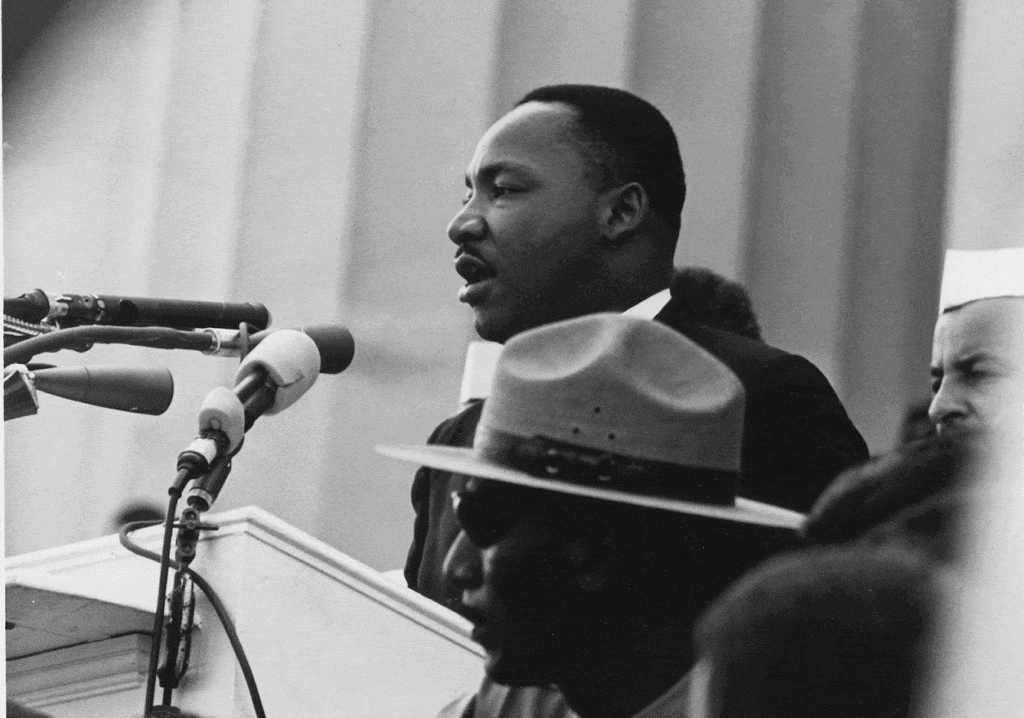
Yesterday was Martin Luther King Jr. Day in the United States. Dr. King’s story is not simple. However, it is an invitation for us all to reckon with the kind of leadership his life demanded and the kind of formation it required.
I’m the son of a Puerto Rican father and Black American mother. This places me firmly in both the Afro-Latino and African American traditions. Not simple. As President of Manna University, I encounter Dr. King as a pastor, a theologian, and a public witness who understood that justice is never separated from suffering and that leadership always carries a cost. I encounter him as a human in need of a savior. We’re well aware that Dr. King did not speak about justice in the abstract or from the safety of an ivory tower. He spoke from within the lived realities of pain, injustice, and moral courage shaped by faith in Jesus Christ, yet shaded by the broken systems and worldviews of fallen humanity. Not simple.
That is why MLK Day continues to matter. It reminds us that the work of justice is not peripheral to Christian leadership. It is central to it.
In my academic work and in my lived experience, I have become increasingly convinced that Christian theological education must grapple honestly with evil, suffering, injustice, and moral injury. These are not theoretical concepts reserved for philosophy classrooms. They are lived realities carried by our students, pastors, leaders, and communities across the globe. I had the honor of presenting research at Oxford in 2025 based on conversations from our students across the US and in Rwanda, Colombia, Venezuela, and Mexico. The consistent thread?
Formation that ignores the realities of evil, suffering, injustice, and moral injury may produce competence, but I’m not necessarily biblical faithfulness.
Much of what we call leadership failure does not stem from ignorance or lack of training. It often grows out of unresolved pressure, accumulated trauma, and internal dissonance between one’s calling and one’s lived experience. What I like to call, “Leadership Fatigue.”
When leaders are forced to carry moral weight without the space to process it redemptively, the result is often exhaustion, cynicism, or collapse. This is what many now recognize as moral injury, the deep wound that occurs when people participate in, witness, or fail to prevent injustice in ways that fracture their conscience.
Dr. King understood this long before the language existed to describe it. What I learn from his leadership is that we must have a theology that refuses to separate justice from the redemption found in the Gospel. The finished work of Christ is the only answer to strongholds of racial and ethnic division that continue to plague our planet.
Vengeance is the Lord’s. Our work:
“He has told you, O man, what is good; and what does the Lord require of you but to do justice, and to love kindness, and to walk humbly with your God?”
(Mic 6:8, ESV)
Scripture does not offer simple explanations for evil and suffering. Instead, it confronts them directly in the life, death, and resurrection of Jesus. Evil is neither dismissed nor rationalized. It is taken seriously, absorbed fully, and transformed through sacrificial love. The cross reveals a God who does not stand above suffering but enters it, bearing injustice to redeem it.
This vision matters deeply for how we form leaders today. Christian leadership is not about escaping suffering or managing it from a safe distance. It is about faithful participation in God’s redemptive work within a broken world. That kind of leadership requires formation that is slow, honest, and deeply rooted in Scripture and community.
The prophet Isaiah speaks of a servant who brings justice quietly, faithfully, and without crushing those already wounded (Isa 42:9). The Gospel of Matthew presents Jesus as the fulfillment of that vision (Matt 12:15-21).
Jesus does not impose justice through force, nor does he abandon righteousness in the name of peace. The Justice of God, redemptive justice, is the putting right of relationships, communities, and ultimately all of creation under the reign of King Jesus.
We can learn much from Dr. King’s vision of the beloved community, especially where it echoes biblical hope found only in union with Christ. Justice, in this sense, is not merely about fairness or outcomes. It is about people becoming whole.
At Manna University, we are not interested in forming leaders who can speak about justice fluently but cannot carry it faithfully. We want to form leaders whose inner lives are aligned with the redemptive mission of the Gospel. Leaders who can name injustice honestly, endure suffering, and remain present in the long work of restoration without losing their soul. We are called to be signposts that point the world to the Kingdom of God and the reign of Jesus.
MLK Day reminds us that justice is not a moment or a slogan. It is a way of life shaped by faith, humility, and perseverance.
As we remember Dr. King this week, my prayer is that we do more than quote his words or paint him as some picture of moral perfection. Instead, may we embody the kind of leadership his life demanded. Leadership that is rooted deeply, formed patiently, and committed to redemptive justice in the world God so loves.
Lead on!
Dr. Carlo A. Serrano, President
Image: Martin Luther King Jr. delivering “I Have a Dream” at the March on Washington, Washington, D.C., 1963. Public domain.