
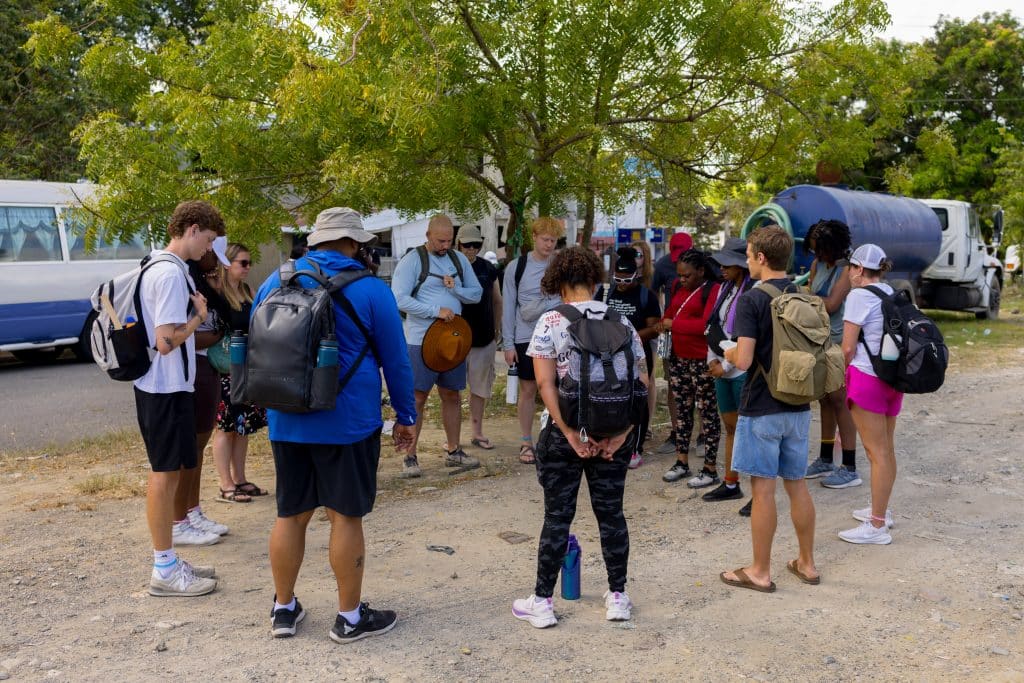
There is a strange moment that happens after you come back from a missions trip.
If you’re like me, you unpack, catch up on emails, and try to fall back into your normal rhythm. And then, almost without realizing it, everything you experienced starts to feel distant.
What felt urgent begins to fade. What felt clear gets crowded out. What felt important gets replaced by what’s familiar.
I’ve noticed that over the years.
You can see a lot, experience a lot, learn a lot, and still come back unchanged.
Part of the challenge is that normal life has gravity.
It pulls you back into routines, expectations, and patterns that were already there before you left. The same emails. The same responsibilities. The same laundry and cooking. The same pressure. If you’re not intentional, those patterns take over.
What you saw doesn’t disappear; rather it gets buried.
You’ve probably felt this in different ways.
You step into a context that stretches you. You see people living with a level of faith, resilience, or generosity that challenges your assumptions. You’re confronted with needs that are real, not theoretical. You have conversations that stay with you longer than expected.
In those moments, things feel clear…and then you come home.
In Jeremiah 29, people who had been displaced and disoriented were told something they probably didn’t want to hear.
God didn’t tell them how to escape. Instead, he told them how to live well where they were.
He said: Build. Plant. Stay. Seek the good of the place you’ve been sent.
In other words, don’t wait for a different setting to live differently.
That’s the challenge for us. Not just to experience meaningful things, but to integrate them and to let what we’ve seen shape how we think, how we lead, and how we live when no one else is watching.
You can experience the global Church and still live with a small perspective.
You can witness real need and still prioritize convenience.
You can be exposed to depth and still settle for surface-level thinking.
It’s not the experience’s fault, it’s ours.
So, the question becomes simple.
What are you going to do with what you saw?
Some will move on quickly.
Others will hold onto the memory for a little while.
A few will make quiet, consistent changes that reshape how they live.
For me, some of this goes all the way back to 2003.
When I came home from Iraq, everything felt different. Not in a dramatic, cinematic way. In small, everyday ways. I remember noticing things I had never paid attention to before. Hot water. Quiet nights. Sitting in a room with my family without wondering what might happen next.
My first trip to England reminded me that time keeps moving whether I’m paying attention or not. I stood in places that have outlasted empires and realized how small my sense of urgency really is.
Rwanda slowed me down. Coffee isn’t rushed there. Meals aren’t rushed. Conversations aren’t rushed. I started to realize how often I moved through life without actually experiencing it.
Egypt was different. I looked at the remains of what was once the most powerful kingdom in the Ancient Near East, and it hit me. Kingdoms rise and fall. All the books in the world could easily be burned up or erased from the cloud. However, God’s Kingdom never ends.
Those moments don’t stay with a person automatically.
You must decide what to do with them.
For me, that shows up in simple, repeatable ways.
I thank God for things I used to overlook. Not in a vague way, but specifically. You’d laugh if you knew how much I literally thank God, out loud, for hot water, safety, and time with people I love.
I try to move a little slower when it matters. To actually sit, listen, and be present instead of rushing to the next thing. (I have a LONG way to go with this one!)
I pursue relationships that stretch me beyond my own context, because I’ve seen how small my world can become if I let it.
When I make decisions, I’m more aware that context matters. People’s stories matter. What looks simple from a distance rarely is up close.
None of that is complicated, but it is intentional.
If I don’t build those things into my life, I’ll forget what I’ve seen.
Many of our students are either about to take a ministry trip, or they’ve recently returned. I love it, but remember:
You don’t always need another trip to grow.
You don’t always need another moment of clarity.
You don’t always need a new environment.
However, you always need to be faithful with what you’ve already seen.
Don’t forget what you saw.
Dr. Carlo A. Serrano, President